
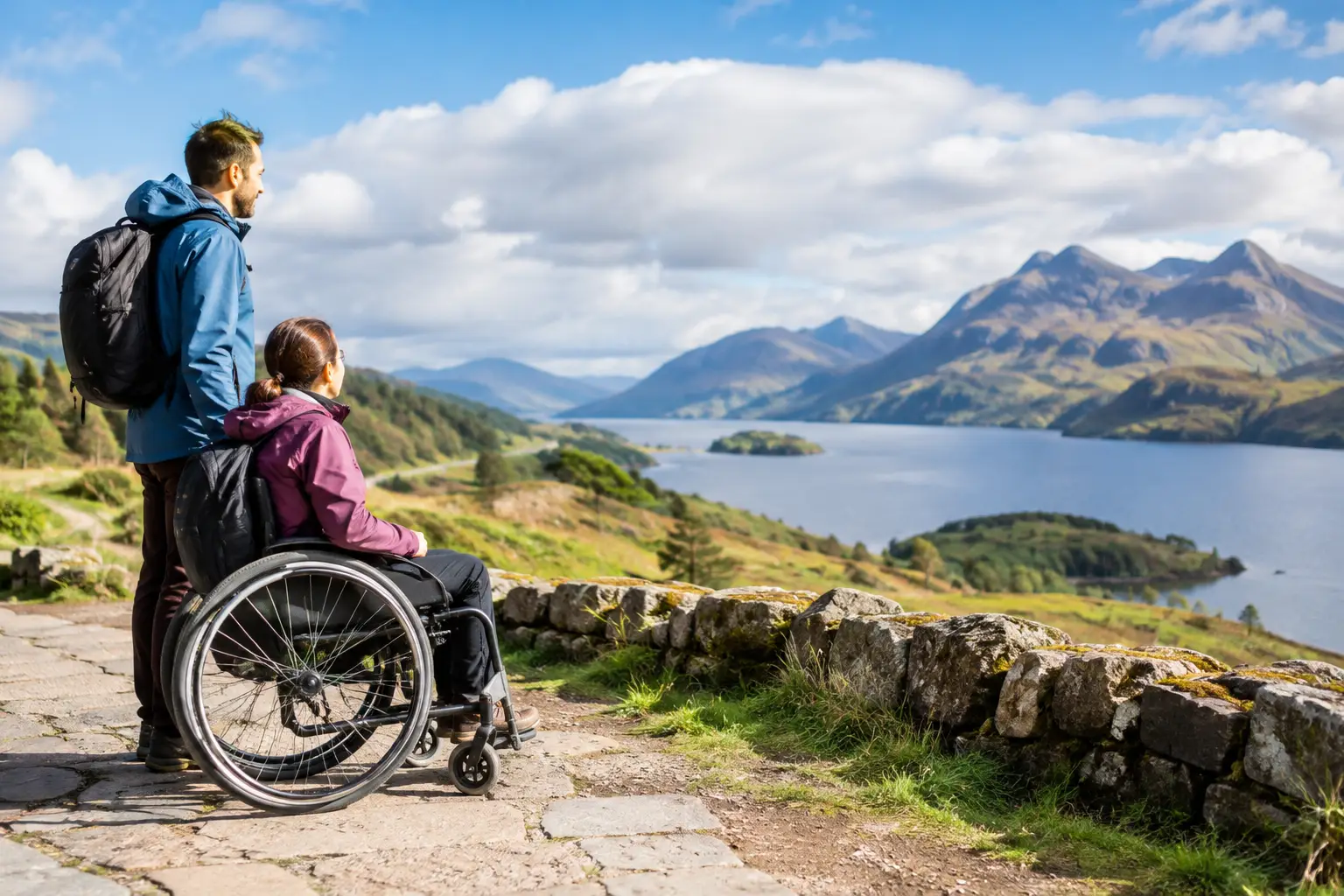
A historic doorway can be only a few centimetres narrower than expected. A cobbled lane can turn a short walk into the most demanding part of the day. For travellers with mobility needs, sensory sensitivities, fatigue, hearing or sight loss, accessible tourism is not a niche consideration. It is the difference between a trip that feels enjoyable and one that requires constant compromise.
Scotland offers extraordinary museums, landscapes, castles and city neighbourhoods, but access varies considerably between places. Older buildings were not designed around modern accessibility standards, while terrain and weather can change what is practical on the day. Good planning does not mean making every minute rigid. It means removing avoidable uncertainty, so there is more room to enjoy the visit.
What accessible tourism should mean in practice
Accessible tourism is often reduced to whether a venue has step-free entry. That matters, but it is only one part of the experience. A genuinely workable day also considers drop-off distance, accessible toilets, seating, gradients, lighting, noise levels, clear information and the ability to adjust plans without stress.
Needs are individual. A wheelchair user may need accurate measurements and reliable lift access. Someone who can walk short distances may still find steep ground, uneven surfaces or long queues difficult. A visitor with autism may prioritise quieter periods, clear routines and the option to step outside. Those travelling with a companion, personal assistant or assistance dog need practical details that general visitor information can overlook.
The most useful approach is to plan around the traveller rather than an accessibility label. Ask what makes a day comfortable, what causes difficulty and where flexibility is needed. This produces a far better itinerary than simply searching for attractions marked as accessible.
Accessible tourism at Scotland's historic places
Scotland's heritage is a major draw, and it also presents the clearest access trade-offs. Castles, closes, stone cottages and battlefield sites often have uneven paths, steps, narrow passages and limited space. That does not mean they should be ruled out. It means checking the experience in detail before building a day around it.
Start with the official visitor access information, then contact the venue if anything is unclear. Online summaries can be brief or out of date, particularly after repairs, weather damage or temporary changes to routes. A quick conversation can establish whether there is level access from the entrance, where accessible parking or drop-off is located, whether a lift is operating and how much of the main visitor route is practical.
Be specific with questions. Rather than asking whether somewhere is wheelchair accessible, ask about the surface from the entrance to the ticket desk, the steepest incline, the width of key doors and the location of accessible toilets. If a companion can assist with a small threshold or one short slope, say so. If independent access is essential, make that clear. The answer may not be perfect, but it will be more useful.
Edinburgh illustrates why this matters. The Old Town is rich in history but includes cobbles, gradients and narrow pavements. The New Town is generally easier to navigate in places, though slopes remain. Planning one principal attraction and one nearby, lower-effort stop is often more enjoyable than trying to cover every landmark in a single day.
Do not treat the car park as the start of the visit
At rural attractions, the distance from parking area to entrance can be significant, and paths may be gravel, grass or exposed to the weather. Ask where a vehicle can stop closest to the entrance and whether that point is available throughout the day. This is especially valuable for visitors managing pain, breathlessness or limited stamina.
For city visits, consider the final approach as carefully as the journey itself. Roadworks, pedestrian zones and busy event days can alter the most convenient drop-off point. A well-planned arrival can preserve energy for the place people have travelled to see.
Build an itinerary with recovery time
The temptation on a first visit is to fit in as much as possible. Accessibility planning usually works better when it gives the day some margin. Allow extra time for transfers between locations, toilet breaks, lifts, finding a quieter route or simply sitting down with a view.
This is not wasted time. It protects the quality of the day. A traveller who has time to pause at a museum café or along a lochside can enjoy the next stop, rather than arriving already exhausted.
Think in terms of anchors rather than a packed timetable. Choose one experience that matters most, add a second only if the locations and energy demands make sense, then keep a calmer alternative in reserve. A gallery, accessible garden, scenic drive or relaxed lunch can be a good substitute if rain, crowds or fatigue make an outdoor site less appealing.
The season affects this calculation. In winter, shorter daylight and wet or icy surfaces may make outdoor routes harder. Summer brings longer days but also busier visitor sites, festivals and more pressure on accessible facilities. Spring and autumn can offer a comfortable balance, although conditions remain changeable. Whatever the month, layers, waterproofs and suitable footwear are practical considerations rather than afterthoughts.
Check access beyond physical mobility
Some of the most valuable travel adjustments are not visible at first glance. Visitors who are deaf or hard of hearing may benefit from captioned films, induction loops, written information or guided experiences where staff can communicate clearly. Blind and partially sighted visitors may want tactile interpretation, audio description, well-defined routes or advance orientation information.
For neurodivergent travellers and people with sensory sensitivities, crowd levels, bright lighting, sound effects and timed entry can have a greater effect than stairs. Ask venues whether they offer quiet sessions, sensory guides, reduced-stimulation periods or a place to take a break. Even where a formal programme is unavailable, staff may be able to suggest a quieter arrival time or less busy entrance.
It is also worth checking the accessibility of practical facilities. Accessible toilets should not be assumed to be open whenever a site is open. Changing Places facilities are still not available everywhere, so travellers who require them should identify suitable locations before setting out. Mobile coverage can be inconsistent in rural areas, making screenshots, printed details and a charged phone sensible backups.
Make transport part of the accessibility plan
A destination can be accessible on paper but difficult to reach comfortably. Public transport can work very well for some journeys, but timetables, platform layouts, luggage, assistance availability and the distance at either end all need consideration. In rural parts of Scotland, services may be limited, especially on Sundays or outside peak season.
For visitors who prefer door-to-door travel, it is helpful to share requirements in advance: the type of mobility equipment being brought, whether it folds, how much assistance is wanted at stops and how much time is needed to get in and out comfortably. Never assume that a vehicle can carry a particular wheelchair, scooter or other item without confirming dimensions and loading arrangements first.
The right travel arrangement depends on the route and the person. A compact folding wheelchair has different requirements from a powered chair; a traveller who values a calm, direct journey may make a different choice from someone happy to use several services. Clear information before departure prevents awkward changes at the kerbside.
Travel with information, not assumptions
Keep a simple plan for each day: the venue's access contact, opening hours, a realistic arrival window, toilet locations and a backup option. If tickets are timed, allow for the fact that heritage sites can have slower entry processes or alternative routes. Carry medication, water and any essential comfort items where they are easy to reach.
Most importantly, give yourself permission to change the plan. Missing one room in a castle or choosing a shorter path does not diminish the trip. The best accessible days are not measured by how much ground is covered, but by whether everyone can participate with comfort, dignity and enough energy to look forward to tomorrow.
Ready to book your journey?
Private chauffeur transfers and Highland tours from Edinburgh, booked online in minutes.
Book Online Instantly