
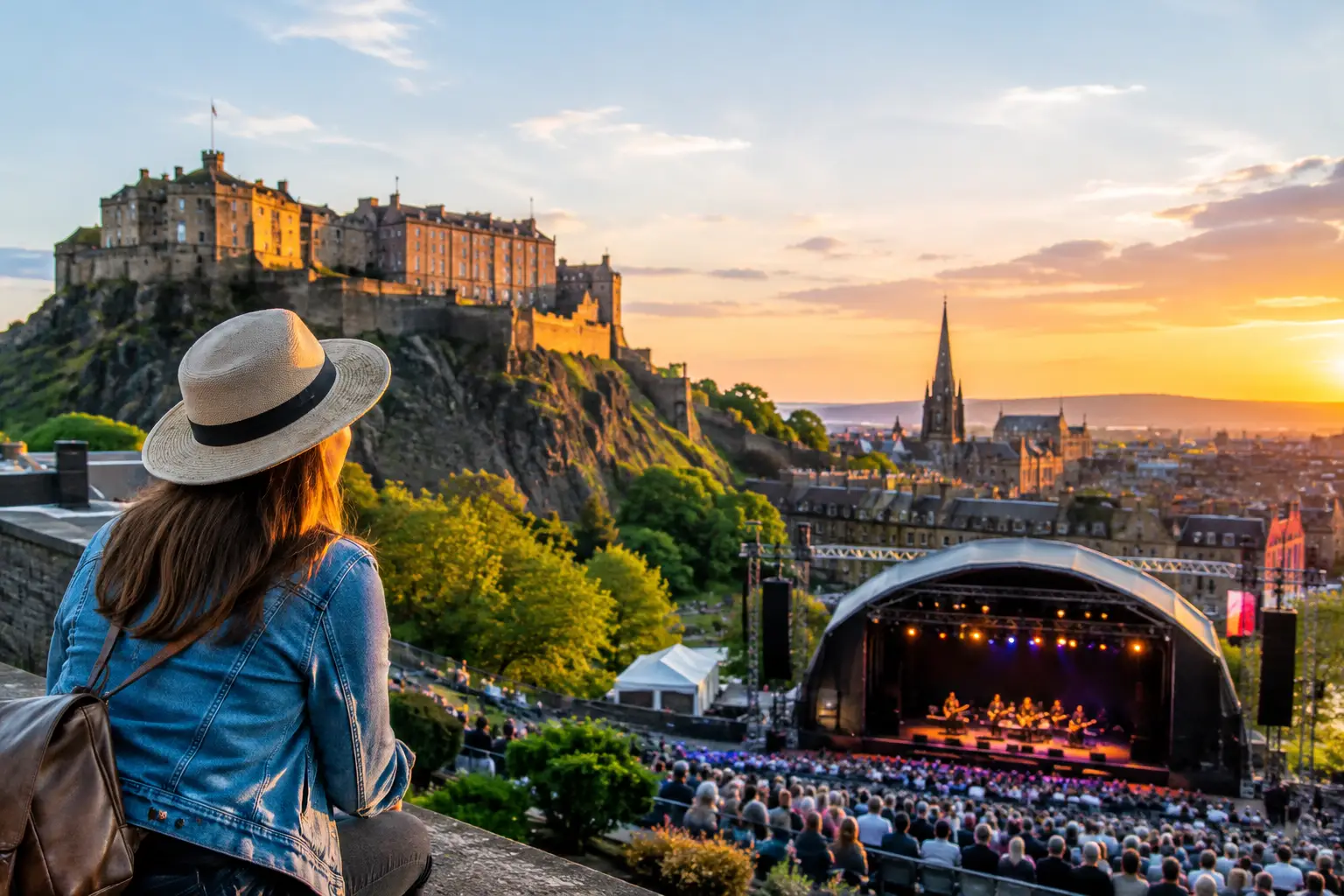
The best Edinburgh festival venues are not necessarily the biggest names on a poster. In August, the right choice can mean the difference between a tightly timed day of excellent shows and an afternoon spent climbing hills, joining queues and missing your next performance. Edinburgh’s festivals use permanent theatres, university buildings, church halls and temporary pop-up spaces, each with a distinct atmosphere and practical character.
For visitors building a Fringe, International Festival or book festival itinerary, location matters as much as the performer. A 60-minute show can take nearer two hours once you allow for walking, finding the correct room, collecting a drink and getting seated. The most successful festival days tend to focus on one or two nearby venue clusters rather than criss-crossing the city.
1. Pleasance Courtyard
Pleasance Courtyard is one of the defining Fringe experiences: busy, energetic and packed with shows from morning until late. Set just off the Royal Mile, it brings together numerous performance spaces around a courtyard where audiences gather between shows. Comedy is especially prominent, but the programme is usually broad enough to include theatre, music, cabaret and family work.
Its great strength is efficiency. You can see several shows in one afternoon without travelling anywhere else, and the atmosphere makes it easy to take a chance on an unfamiliar act. The trade-off is intensity. It can feel crowded at peak times, and popular rooms may involve a queue even if you have a ticket. Allow a generous gap between performances, particularly at weekends.
The approach from the Old Town is steep in places. Visitors with limited mobility should check the current venue access information and the specific performance space before booking, rather than assuming every room has the same facilities.
2. Assembly Hall and Assembly George Square
Assembly operates across several sites, but Assembly Hall and Assembly George Square are among the most useful bases for a Fringe schedule. Assembly Hall, close to the Mound and George IV Bridge, is a striking historic setting with a central location. George Square, beside the university, is a large festival hub whose tented spaces host a vast range of comedy, theatre and late-night events.
Choose Assembly Hall when you want to stay close to the Royal Mile, the National Museum of Scotland and the central Old Town. Choose George Square when your day includes university-area venues, Summerhall or the Festival Theatre. George Square is often a good option for visitors who prefer a clear, contained site with food and refreshment choices close by.
Do not treat both as interchangeable. They are walkable, but Edinburgh’s slopes, crowds and narrow pavements make a short distance take longer than it appears on a map. A 30-minute interval is sensible if you are moving between separate sites and want time to find the right entrance.
3. Summerhall
Summerhall is one of the city’s most distinctive festival settings. The former veterinary college near The Meadows has a more independent, exploratory feel than the largest Fringe hubs. Its programme often rewards audiences looking for contemporary theatre, experimental work, spoken word, art and unusual late-night performances.
The building itself is part of the appeal. Its corridors, courtyards and performance rooms create a sense that something is always happening, and it is well placed for combining a festival visit with a walk through The Meadows or the Southside’s cafés and restaurants.
It is less convenient for a schedule concentrated around Princes Street or the west end, so Summerhall works best as a destination rather than a quick stop between central shows. Build around it for half a day, and leave extra time to identify the individual room once you are inside.
4. Traverse Theatre
For contemporary Scottish and international theatre, Traverse Theatre is among the most dependable choices. Situated at the west end of the city centre, near Lothian Road, it has a year-round reputation for new writing and thoughtful productions. During festival season, its programme can feel more curated than the enormous Fringe listings, which is useful if you would rather make fewer, more considered choices.
The venue’s location also makes it practical. It sits close to Usher Hall, the Lyceum, the Edinburgh International Conference Centre area and numerous restaurants. That makes it a strong anchor for an evening that combines a performance with dinner, rather than a day of rapid venue-hopping.
The main consideration is distance from the Old Town. It is perfectly manageable on foot, but not a last-minute dash from a Royal Mile show. If you are arranging a special evening or travelling with guests unfamiliar with the city, plan your arrival point and onward journey in advance.
5. Usher Hall
Usher Hall is one of Edinburgh’s foremost concert venues and an important home for the Edinburgh International Festival. Its grand auditorium is suited to orchestras, major visiting artists, gala performances and large-scale music events. For audiences who value a more formal concert experience, it offers a very different rhythm from the Fringe’s temporary rooms and improvised stages.
The surrounding area is one of the easiest parts of the city centre for an evening out. Lothian Road provides plenty of pre-performance dining options, while Princes Street and the west end are within straightforward reach. That said, major events can bring busy pavements and road restrictions, particularly during August.
Check bag policies and arrival guidance before leaving your accommodation. For a high-profile concert, arriving shortly before the advertised start time is rarely relaxing, and late seating may be restricted depending on the performance.
6. The Queen’s Hall
The Queen’s Hall, in the Southside, offers a more intimate musical setting than Usher Hall. A converted church with excellent acoustics, it regularly features classical music, folk, jazz and singer-songwriters. It is a particularly appealing choice for visitors who want a high-quality performance without the scale or formality of a major concert hall.
Its position near the University of Edinburgh and Summerhall makes it easy to pair with the Southside festival circuit. It also gives you an excuse to see a less heavily touristed side of the city, with the Meadows, Nicolson Street and the lower edge of Holyrood Park nearby.
Because the hall is not in the middle of the Old Town, it is worth planning the return journey after a late show. August evenings remain lively, but weather and crowd conditions can change quickly, especially after an outdoor event or a full day on foot.
7. The Festival Theatre
The Festival Theatre is a leading choice for opera, ballet, musical theatre and larger-scale drama. Its auditorium and stage capacity allow for productions that cannot be replicated in smaller Fringe spaces, while its location on Nicolson Street places it close to George Square and the Southside.
This is an excellent venue for a planned cultural evening, particularly for visitors attending the Edinburgh International Festival. The experience is more structured than a pop-up Fringe room: assigned seating, a defined start time and a substantial production that rewards arriving settled rather than rushing in from another show.
When selecting seats, consider the nature of the production. For opera or ballet, a central view can matter more than being close to the stage. For spoken drama, the balance may be different. The venue’s seating plan and production notes are useful guides, especially if this is the main event of your trip.
8. Gilded Balloon venues
Gilded Balloon is a Fringe institution, known especially for comedy, new talent and late-night programming. Its venues can change or expand from year to year, which is typical of Edinburgh in August, but the name remains a reliable indicator of a lively, audience-focused Fringe experience.
The advantage is the chance to see emerging performers before they become household names. The risk, if it can be called that, is that the best discoveries are not always the most obvious choices in the programme. Leave room in your schedule for one show selected on instinct, a recommendation or a strong programme description.
Before booking, confirm the exact venue address and performance space. Festival operators may use more than one building, and Edinburgh’s August programme evolves each year. The same principle applies across the city: always rely on the current festival listing rather than an old map or previous visit.
How to choose the right festival venue for your day
The best approach is to choose by cluster and by mood. The Royal Mile and Pleasance area suits visitors who want the classic Fringe buzz. George Square, Summerhall and the Festival Theatre create a strong Southside route. Traverse and Usher Hall work well for a polished west-end evening, while the Queen’s Hall offers a quieter musical alternative.
Be realistic about what you can fit in. Three shows with comfortable gaps, a proper meal and time to absorb the city will often be more enjoyable than six tightly packed bookings. Edinburgh’s cobbles, gradients and August crowds are part of the experience, but they are easier to enjoy when your timetable has some breathing space.
For guests travelling to a performance with luggage, formalwear or a fixed curtain time, pre-arranged transport can remove uncertainty around the busiest arrival periods. AlbaGo can provide a discreet, pre-booked journey in an executive vehicle, allowing the evening to begin at the venue rather than on the pavement.
A memorable Edinburgh festival itinerary leaves space for the unexpected: a performer you have never heard of, a courtyard conversation, or a show that runs late because the audience will not stop laughing. Pick a sensible venue base, arrive unhurried, and let the city do the rest.
Ready to book your journey?
Private chauffeur transfers and Highland tours from Edinburgh, booked online in minutes.
Book Online Instantly