
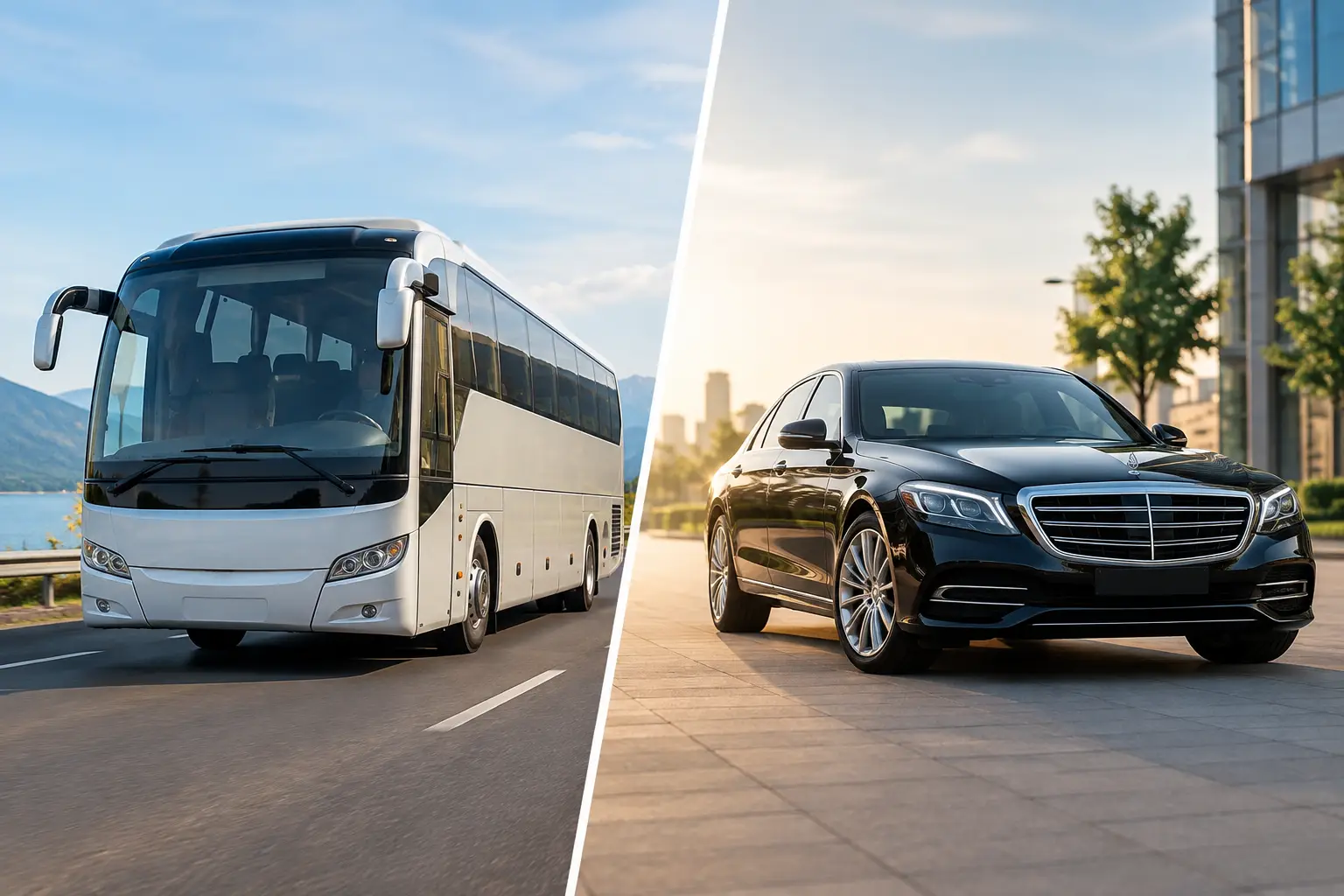
A group coach versus executive car decision is rarely just about passenger numbers. It affects where your party can be collected, how easily everyone keeps to the same schedule, how much luggage can travel with them and whether the journey feels like a necessary transfer or a well-managed part of the day.
For visitors planning a Scottish itinerary, the right answer depends on the shape of the group and the purpose of the journey. A coach can be the sensible choice for a large party travelling together. An executive car is often better suited to smaller groups who value privacy, flexibility and a more personal standard of travel. Understanding the practical differences before confirming transport prevents avoidable compromises later.
Group coach versus executive car: the main difference
A group coach is designed to move a high number of people in one vehicle. It offers a single departure point, one driver and a clear solution when keeping the whole party together matters most. For schools, large family gatherings, club outings and organised visitor groups, that shared structure is often its greatest advantage.
An executive car operates on a smaller scale. It is typically chosen by individuals, couples or small parties who prefer a quieter journey, more direct access and room to adapt the day around their own plans. The experience is less about filling seats and more about comfort, discretion and careful timing.
Neither option is automatically superior. A 30-person group would find several executive cars harder to co-ordinate and less efficient than a coach. Conversely, four people travelling to a city-centre restaurant, country house hotel or historic site may find a large vehicle unnecessarily formal and less convenient on narrow approach roads.
Start with the real number of travellers
The headline passenger count is a useful starting point, but it should not be the only one. Ask how many people need to travel at the same time, whether anyone is joining later and whether the party must remain together throughout the day. A coach works best when the group has one itinerary and a shared pace.
For a smaller party, an executive car gives each traveller more personal space and avoids the feeling of travelling as part of a larger organised group. This can be especially appropriate for couples, families with older children, visiting relatives and guests attending a special occasion.
It is also worth considering the group’s expectations. A party of eight may technically fit a larger vehicle, but if they are carrying smart clothing, presentation materials or substantial luggage, the practical requirements may point towards more than one vehicle or a different vehicle category. Capacity on paper is not always the same as comfortable capacity in real use.
When a coach makes sense
A coach is generally the stronger option when the priority is collective movement. It allows a large group to leave together, arrive together and avoid the administrative burden of assigning people across several cars. This matters for timed entries to attractions, theatre visits, group meals and itineraries with a fixed programme.
It can also create a sociable atmosphere. Guests can talk during the journey, an organiser can make announcements, and no one is left wondering whether another vehicle has taken a different route. For a day built around a shared experience, that simplicity has real value.
There are limits to consider. Coaches need suitable access and space to stop safely. Scotland’s older town centres, rural lanes, hotel driveways and some attraction car parks can be restrictive. A vehicle may need to set down at a designated point rather than directly at the entrance, leaving the group with a short walk. This is usually manageable, but it should be factored into timings, particularly for guests with limited mobility.
When an executive car is the better fit
An executive car is most compelling when the party is small and the day has individual requirements. It can be a practical choice for an arrival at a hotel, an evening engagement, a private sightseeing plan or a visit that calls for a calm, polished journey rather than group logistics.
Smaller vehicles are often better able to access central locations and rural properties with restricted approaches. They can make collection and drop-off feel more direct, which is valuable when passengers are carrying luggage, dressed for an event or unfamiliar with the area.
The atmosphere is different, too. A private car allows room for conversation, quiet preparation or simply a chance to relax between plans. For guests who have travelled a long way or who want a more discreet experience, that difference can be meaningful even on a relatively short journey.
Luggage can change the answer quickly
Luggage is one of the most common reasons a transport plan becomes uncomfortable. A group travelling for a day out may need very little space beyond coats and small bags. The same number of people arriving for a week in Scotland may have cases, hand luggage, outdoor clothing and equipment that significantly alter the vehicle requirement.
Do not assume that every passenger can bring a large suitcase simply because there is a seat available. Tell the transport provider the number and approximate size of bags when making arrangements. A clear luggage brief is particularly important for multi-stop itineraries, when cases must be loaded and unloaded more than once.
A coach has generous overall storage for a large party, especially where luggage is carried in dedicated compartments. An executive car has more limited luggage capacity, although this is usually ample for one or two passengers and can work well for small groups travelling light. The best choice depends on the balance between people and bags, not either figure alone.
Think about the road, not only the route
Scottish journeys can change character quickly. A main road between cities may be straightforward, while the final few miles lead through a village, along a single-track road or towards an estate entrance with limited turning space. A coach and an executive car will not experience those conditions in the same way.
If your plans include remote castles, distilleries, coastal villages or countryside accommodation, check the precise collection and drop-off points. A coach may still be entirely suitable, but the route may need an agreed set-down location. Smaller vehicles usually offer more flexibility at the final approach, although access should never be assumed without checking.
Timing also matters. A coach requires longer for passenger boarding, headcounts and stops, especially with a large group. That is not a flaw - it is simply part of operating an organised itinerary. Build realistic time around each movement rather than treating a 20-minute drive as a 20-minute transfer from door to door.
Comfort, privacy and the purpose of the day
The best vehicle should reflect what the journey needs to achieve. On a group outing, shared seating and a consistent timetable may matter more than personal privacy. A coach is built around that collective experience.
For smaller parties, comfort often means something more specific: a quiet environment, professional presentation, space to settle in and the reassurance that the journey is being handled carefully. An executive car suits occasions where the travel experience should feel considered, whether guests are heading to a dinner reservation, a cultural event or a private day of sightseeing.
There is also a question of group dynamics. If travellers do not know each other well, one large coach may be perfectly appropriate for a formal outing. For a senior guest, visiting family or a small party celebrating an occasion, separate private travel can feel more natural. The right choice is the one that matches the social tone of the day rather than forcing everyone into the same format.
One vehicle or several smaller ones?
For medium-sized groups, the choice is not always coach or car. Several executive vehicles can provide a more flexible arrangement, particularly where guests have different departure points, return times or luggage requirements. This can be useful for parties staying at more than one hotel or combining daytime plans with separate evening arrangements.
The trade-off is coordination. Multiple cars require clear passenger allocations, contact details and a plan for keeping the group aligned at each stop. A coach removes much of that complexity because everyone is travelling together. Where the itinerary is fixed and the group is large, one vehicle is usually easier to manage.
Where flexibility and privacy outweigh the need for a shared journey, several smaller vehicles may be worth considering. The decision should be based on how the day will actually run, not simply on which option appears more prestigious.
Questions to settle before choosing
Before confirming transport, establish the total passenger count, the number and size of bags, every collection and drop-off point, and whether the group must remain together. Consider access at each venue, including parking, turning space and walking distance from the vehicle to the entrance.
It also helps to decide what matters most: keeping the group together, giving guests privacy, reaching a precise doorstep, carrying substantial luggage or maintaining a tightly timed itinerary. Once those priorities are clear, the appropriate vehicle type is usually clear as well.
A well-planned journey should make the day easier, not create another set of arrangements for someone to manage. Choose the vehicle around the people, places and pace involved, and travellers can focus on where they are going rather than how they will get there.
Ready to book your journey?
Private chauffeur transfers and Highland tours from Edinburgh, booked online in minutes.
Book Online Instantly