
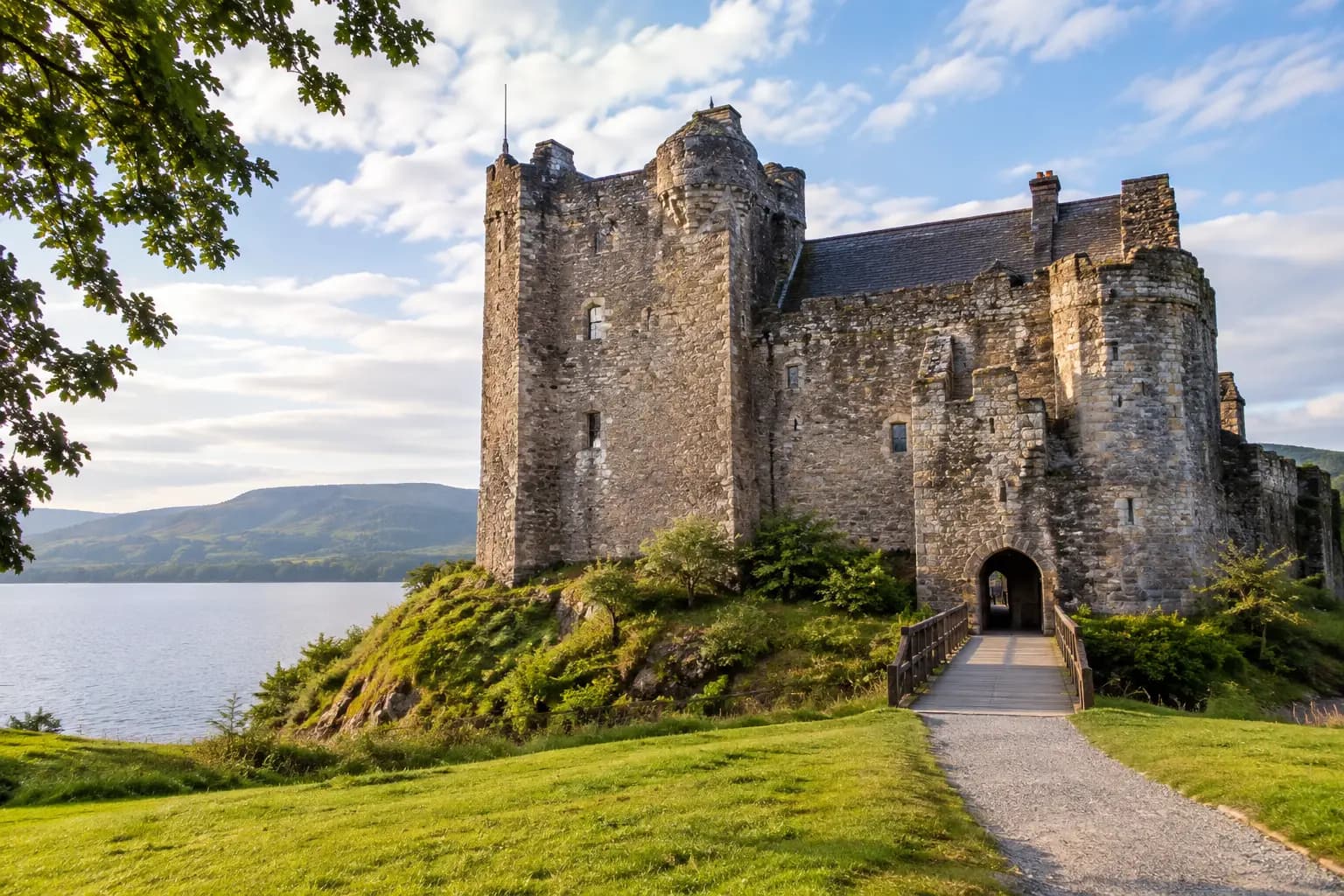
Doune Castle rewards visitors who allow time to look up. Its vast medieval gatehouse, high great hall and atmospheric courtyard are far more impressive when you are not trying to squeeze them into a hurried stop between other attractions. If you are deciding how to visit Doune Castle, the key is simple: plan the practical details in advance, then leave enough room to explore at an unhurried pace.
Set above the village of Doune, near Stirling, the castle is a strong choice for travellers who want a substantial historic site without committing to a full day in a large city. It is also familiar to many screen visitors, having appeared in productions including Monty Python and the Holy Grail, Outlander and Game of Thrones. The filming connection may bring people through the gate, but the building itself is reason enough to go.
Choose your timing before you travel
Doune Castle is managed by Historic Environment Scotland, and opening arrangements can change with the season, conservation work, weather and special events. Check the official opening hours and ticket information shortly before travelling rather than relying on an old itinerary or a third-party listing.
Late morning is often the busiest period, especially during school holidays and the main summer season. Arriving close to opening time can mean a quieter first walk through the courtyard and more time to take photographs without waiting for space. A later-afternoon visit can also be pleasant, provided you allow enough time before last entry and do not underestimate the journey back.
For most visitors, allow around 90 minutes at the castle. Two hours is more comfortable if you enjoy reading interpretation panels, using the audio guide or taking photographs. The site is compact compared with some Scottish estates, but its rooms have enough detail to hold your attention: the great hall’s timber roof, the old kitchens, the lord’s hall and the views from upper levels all deserve more than a quick glance.
If you are travelling from Edinburgh, treat Doune as the main feature of a day rather than a short detour. The drive commonly takes around 90 minutes each way, depending on traffic and your starting point. Building in a little contingency makes the day considerably more relaxed.
How to visit Doune Castle by car or public transport
Driving offers the greatest flexibility, particularly if you would like to combine Doune with Stirling, Callander or a scenic stretch through the Trossachs. There is visitor parking near the castle, but capacity is not unlimited. On a busy summer weekend, arriving early is wiser than assuming there will be a convenient space later in the day.
The route from Edinburgh generally heads west and north-west towards Stirling before continuing to Doune. Roads are straightforward in normal conditions, though they can be slower during peak weekend traffic, major Stirling events and poor winter weather. If you are not used to driving on rural Scottish roads, remember that daylight is limited in winter and conditions can change quickly beyond the central belt.
Public transport is possible, though it requires more attention to timetables. Stirling is the most useful rail hub, with onward bus services towards Doune and Callander. From the village, the castle is within walking distance, but the final approach is uphill in places. Check current rail and bus times carefully, especially on Sundays and public holidays, and leave a sensible margin for connections.
A pre-arranged private journey can suit visitors who prefer to avoid coordinating connections or parking, particularly when travelling as a couple, family or small group. It also makes it easier to set a pace that suits the day rather than a fixed timetable. AlbaGo can be considered where a planned, comfortable journey from Edinburgh is part of a wider private touring itinerary.
Book tickets and prepare for the castle itself
Advance booking is sensible during the busiest months, even when walk-up entry may be available. It gives you clarity on entry arrangements and avoids the disappointment of arriving after a long journey to find limited availability. If you hold a relevant historic-sites membership, check whether admission is included and whether timed entry still applies.
Wear shoes with decent grip. Doune Castle is a real medieval structure, not a purpose-built museum, so expect uneven stone surfaces, narrow passages and staircases. The upper rooms and viewpoints involve steps, and some areas may feel tight for anyone uneasy with heights or enclosed spaces.
The audio guide is worth considering, particularly for a first visit. It brings the rooms into focus and helps explain how the castle changed from a defensive stronghold into a residence designed to impress. If you are visiting because of a filming location, the commentary can be useful, but do not let that become the whole experience. Doune’s history reaches back well beyond its television and film appearances.
Accessibility considerations
The nature of the building means access is limited in some sections. Ground-level areas may be more manageable, while upper rooms and towers are reached by stairs. Anyone with mobility needs should check the latest accessibility information before setting out, including parking, route surfaces, toilet provision and which parts of the castle are currently open.
This is one occasion where honest planning matters more than a packed itinerary. If a member of your party cannot comfortably manage uneven ground or stairs, allow time to enjoy the accessible sections rather than trying to keep pace with visitors heading to every upper level.
What to see once you are inside
Start in the courtyard and take a moment to understand the shape of the place. The enormous gatehouse dominates the entrance, while the surviving ranges of rooms give a clear sense of the castle’s former status. Much of what visitors see today dates from the late 14th century, when the powerful Duke of Albany transformed an earlier fortification into a grand residence.
The great hall is the standout interior. Its scale, high roof and raised dais make it easy to imagine formal feasts and political gatherings taking place here. Look for the musicians’ gallery, a small but revealing detail that gives the room a sense of movement and occasion.
The kitchens are another highlight, less polished but especially evocative. They help connect the formal display of the great hall with the labour required to run a household of this size. From there, follow the route through the smaller chambers at your own pace. The best moments at Doune are often the quiet ones: light falling across old stone, a narrow stair turning out of sight, or a view over the surrounding countryside from a high window.
Photography is generally part of the pleasure, but be considerate in narrow rooms and on stairways. Step aside rather than stopping in a bottleneck, and keep an eye on children near drops and uneven edges.
Build a sensible day around Doune
Doune works well with one or two nearby stops, not five. Stirling Castle is the obvious addition for visitors with a strong interest in Scottish history, but pairing two major castles can feel repetitive unless you have a full day and genuine enthusiasm for both. Stirling is larger, busier and needs its own time, so consider whether you would rather give each site proper attention.
For a quieter contrast, spend time in Doune village before or after your visit, or continue towards Callander for a change of scenery. The road in that direction leads towards the Trossachs, where the landscape becomes noticeably more wooded and open. This is particularly appealing in late spring, early autumn and on clear winter days, when the light can be excellent but daylight is shorter.
Bring water and a light layer even in summer. Castle interiors can feel cool, and Scottish weather is never obliged to follow the forecast. In winter, a waterproof outer layer and shoes suitable for wet paths are more useful than an ambitious schedule.
A few practical mistakes to avoid
The most common mistake is treating Doune as a ten-minute photo stop. The castle may look compact from outside, but its interiors and upper passages are the reason to visit. Another is relying on a single public transport connection without checking the return service, particularly outside the main season.
It is also worth avoiding an over-planned filming-location checklist. Doune is recognisable on screen, but its character comes from the medieval fabric, its unusual survival and the way its rooms still feel purposeful. Give yourself time to see the place as a castle first.
When you leave, pause at the approach road for one final view of the gatehouse above the trees. It is a fitting reminder that the best visits to Doune Castle are not the fastest ones, but the ones with enough time for the building to speak for itself.
Ready to book your journey?
Private chauffeur transfers and Highland tours from Edinburgh, booked online in minutes.
Book Online Instantly