
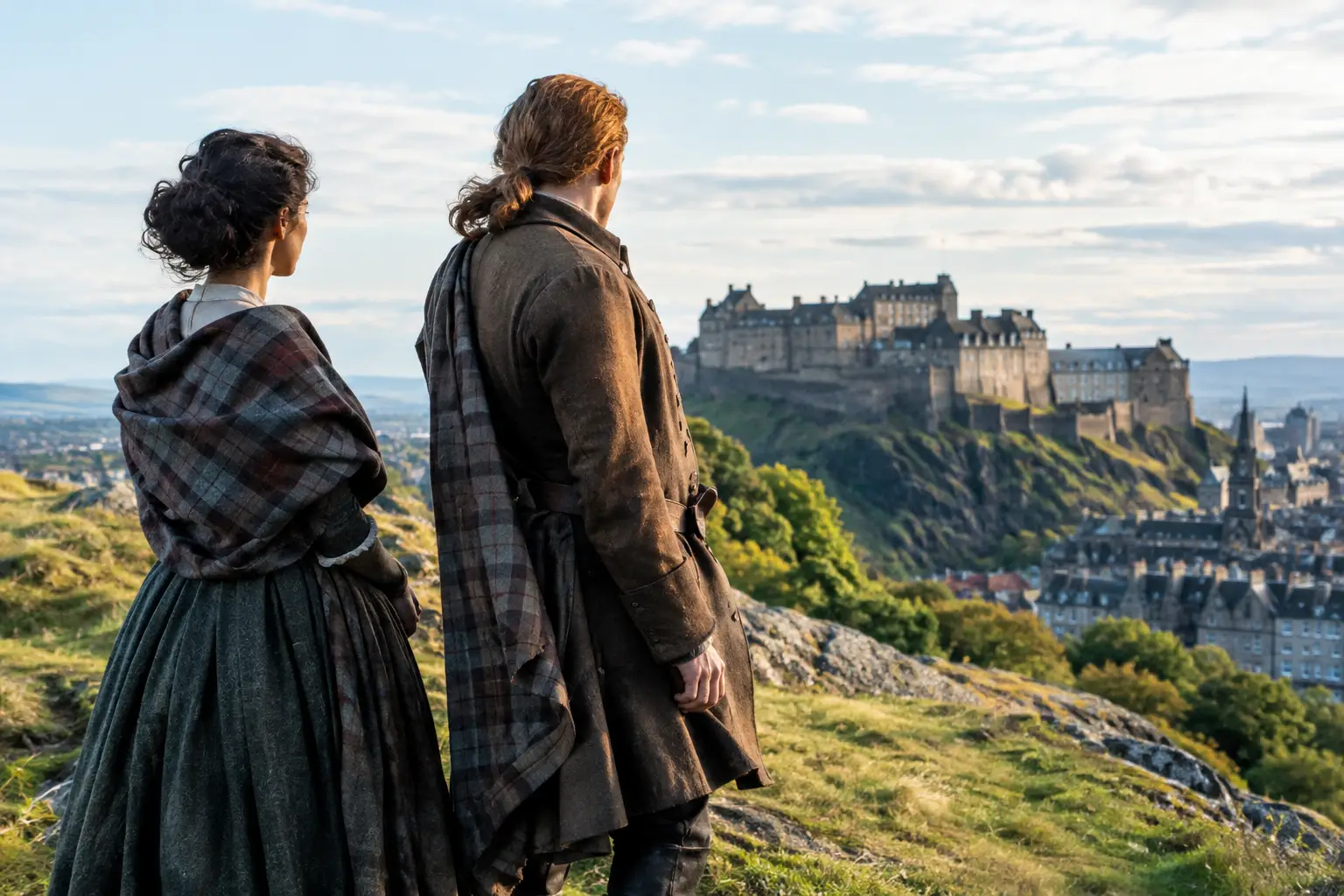
A stone courtyard in Culross can become 18th-century Cranesmuir; a fortress on the Firth of Forth becomes Fort William. That is the pleasure of visiting Outlander filming locations near Edinburgh: many are real, remarkably well-preserved places with histories that stand up perfectly well without a camera crew.
The practical challenge is that the sites are spread across West Lothian, Fife and Stirlingshire. A map may make them appear close together, but castle opening times, country-road driving and limited parking can quickly turn an ambitious plan into a rushed day. The best approach is to group locations by area and allow time to see the place itself, not simply take a photograph and move on.
The best Outlander filming locations near Edinburgh
Blackness Castle: Fort William
Blackness Castle is one of the most immediately recognisable locations in the series. Its dramatic position on the shore of the Firth of Forth and long, narrow profile led to its nickname, the ship that never sailed. On screen, it became Fort William, the military garrison associated with some of the story's most difficult scenes.
It is around 20 miles west of central Edinburgh and works particularly well as a first stop. The ramparts offer wide views across the water towards Fife, while the interior reveals a building with a much longer story than its television role. The castle has served as a royal fortress, prison and artillery stronghold since the 15th century.
Allow roughly an hour to explore, longer if you enjoy historic interpretation. Opening arrangements can change by season, so check before setting out. The site is exposed to the wind, even on a bright day, and sturdy footwear is sensible on uneven stone surfaces.
Midhope Castle: the exterior of Lallybroch
For many viewers, Midhope Castle is the essential stop. Its weathered frontage was used as the exterior of Lallybroch, Jamie Fraser's family home. The building sits within the wider Hopetoun Estate, close to South Queensferry, and its isolated setting explains why it worked so convincingly on screen.
There is an important limitation: Midhope is a private, unoccupied historic building and access is not guaranteed. The interior is not open to visitors, and entry to the estate can be restricted for filming, estate operations, events or safety reasons. Do not assume that a photograph taken by another visitor reflects current access conditions.
When access is available, this is best treated as a brief, respectful visit rather than a full castle tour. The route can be muddy after rain, and facilities are limited. Combining Midhope with Hopetoun House can make better use of the journey, although Hopetoun House has its own seasonal opening pattern.
Linlithgow Palace: Wentworth Prison
Linlithgow Palace provided the setting for Wentworth Prison. The roofless royal palace has a striking, theatrical quality, with great halls, towers and arches arranged around a fountain-filled courtyard. It is also the birthplace of Mary, Queen of Scots, giving the visit historical weight beyond its screen appearance.
The town is roughly 18 miles from Edinburgh, with rail connections as well as road access. This makes Linlithgow one of the easier locations for independent visitors. A walk around Linlithgow Loch adds a calmer contrast to the palace and offers excellent views back towards the ruins.
Because the palace represents emotionally intense scenes, some visitors expect a dark, enclosed prison setting. In reality, it is an expansive Renaissance royal residence. That difference is part of the fascination: television framing and production design transform familiar historic spaces very effectively.
Bo'ness and Kinneil: a useful addition for detailed fans
Bo'ness, on the southern shore of the Firth of Forth, has appeared in several forms across the series. The preserved railway station was used for period travel scenes, while the Kinneil Estate has supplied settings including the grounds around Kinneil House. The town's traditional streets and industrial heritage made it a flexible production location.
This is a worthwhile addition for visitors who have more than a single day or who are particularly interested in the practical craft of filming. It pairs naturally with Blackness Castle and Linlithgow Palace, avoiding the need to cross into Fife. The railway's visitor operations and Kinneil House opening dates are separate from the wider estate, so confirm what is available on your chosen date.
Outlander locations in Fife worth the extra time
Culross: Cranesmuir brought to life
Culross is often the most rewarding location for visitors because so much of the village remains intact. Its steep lanes, pantiled houses and ochre-coloured buildings became Cranesmuir, home to Geillis Duncan and the setting for several early episodes. Mercat Cross and the area around the historic palace will be familiar even to casual viewers.
The village is around an hour from Edinburgh in normal conditions, but it deserves more than a quick stop. Park considerately, as Culross is a working village with narrow streets and residents. Then explore on foot. The palace garden, with its period-style planting and raised beds, is especially appealing in spring and summer.
Culross is also an excellent choice for travellers who prefer a gentler itinerary. There are places to pause for refreshments, coastal views nearby and enough architectural detail to reward an unhurried wander. Wet weather can make the cobbles slippery, so shoes with grip are more useful than fashion-led footwear.
Aberdour Castle: monastic and noble settings
Aberdour Castle, near the Fife coast, was used for monastery-related scenes and offers a quieter alternative to the better-known stops. It is one of Scotland's oldest standing castles, with layers of medieval, Renaissance and later domestic architecture. Its walled garden alone makes it a pleasant visit when conditions are fair.
The location is not as instantly recognisable as Midhope or Blackness, which can be an advantage. It tends to suit visitors who want a stronger sense of place and less emphasis on recreating a specific shot. From Edinburgh, it can be combined with a journey over the Forth and a visit to Culross, although fitting both into a short winter day can feel hurried.
Falkland: 1940s Inverness
Falkland is farther north in Fife, but it is one of the series' most recognisable villages. It appeared as 1940s Inverness, including the familiar Bruce Fountain and the square where Claire and Frank spend time at the beginning of the story. The village's handsome conservation architecture needs very little imagination to feel cinematic.
Allow at least 75 to 90 minutes from Edinburgh, depending on traffic and your starting point. Falkland Palace is a substantial attraction in its own right, while the village has independent cafés and a compact centre that is easy to explore on foot. If your time is limited, choose between Falkland and Culross rather than trying to force both into a packed schedule.
How to plan a realistic day
For a single-day itinerary, the west-of-Edinburgh group is the most efficient: Midhope Castle, Blackness Castle, Linlithgow Palace and, if time allows, Bo'ness. It keeps driving distances manageable and offers a good balance of recognisable sets and significant historic sites.
Culross and Aberdour make a sensible Fife-focused day. Add Falkland only when you can start early and are comfortable with a fuller schedule. Private transport can be particularly useful for groups who want to visit several rural sites without managing parking, train changes or a return drive after dark, but the right arrangement depends on the size of your party and how much time you want at each stop.
Summer brings longer daylight and better chances for outdoor photographs, though popular locations are busier. Spring and autumn can be ideal for softer light and fewer visitors. In winter, the short days make it wiser to focus on two or three places, especially when scheduled historic attractions may have reduced hours.
A few details that make the visit better
Treat filming locations as historic places first. Stay on marked paths, respect barriers and avoid entering private land or residential areas for a particular angle. Several locations are cared for by heritage organisations or estate teams, and access depends on visitors behaving responsibly.
Before travelling, check each site's current opening days, admission arrangements and any event closures. This matters most for Midhope Castle, Hopetoun Estate, Kinneil House and seasonal attractions. Bring a waterproof layer even when the forecast is favourable, and leave room in the day for slow-moving traffic around villages and popular visitor sites.
The best Outlander itinerary is not the one that ticks off every pin on a map. It is the one that leaves you with time to stand on Blackness ramparts, walk Culross's cobbles and appreciate why Scotland's real landscapes needed so little transformation for the screen.
Ready to book your journey?
Private chauffeur transfers and Highland tours from Edinburgh, booked online in minutes.
Book Online Instantly