
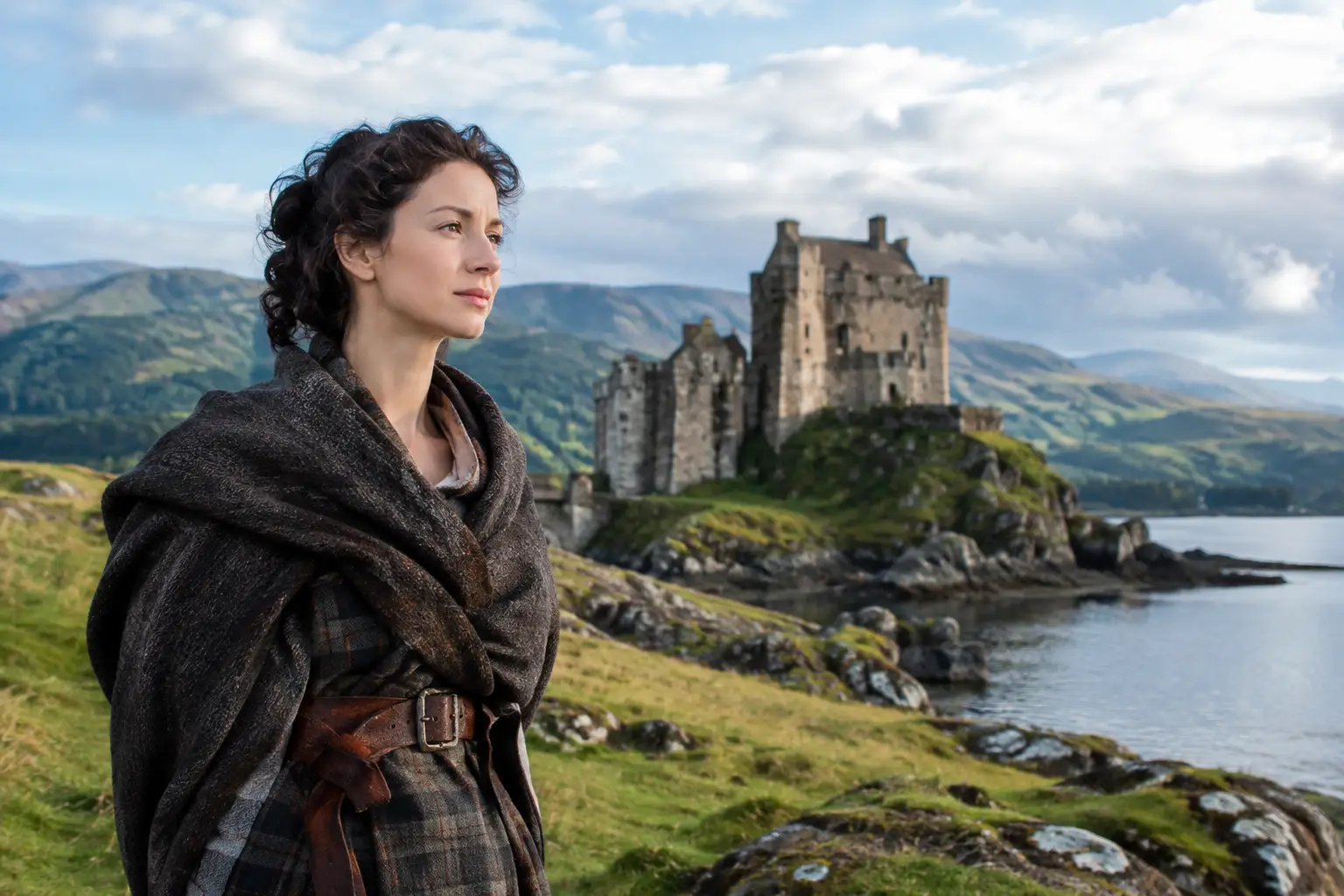
The most memorable Outlander filming locations are not arranged as a single attraction. They are spread across villages, castles, country estates and Highland landscapes, often with limited opening hours or seasonal access. That is part of their appeal, but it also means a little planning makes a considerable difference.
For visitors based in Edinburgh, the strongest locations fall into two broad groups: the historic sites of Fife, West Lothian and Stirlingshire, and the more distant Highland scenery associated with Claire and Jamie’s earliest journey. The first group can be combined thoughtfully in a day. The second deserves more time, particularly when daylight is short.
The essential Outlander filming locations near Edinburgh
Midhope Castle: Lallybroch
For many viewers, Midhope Castle is the location that feels most immediately connected to the story. Its weathered 16th-century exterior was used as Lallybroch, Jamie Fraser’s family home. The building sits on the Hopetoun Estate near South Queensferry, roughly west of Edinburgh.
Midhope is best approached with realistic expectations. Visitors come for the exterior and the sense of place, not a furnished interior experience. The castle is usually viewed from outside, and access can be restricted by estate operations, private events, filming or seasonal conditions. It is essential to check current visitor arrangements before setting out rather than assuming the gate will be open.
The surrounding estate roads and the castle’s rural setting are part of what makes the stop worthwhile. Allow enough time to walk from the permitted parking area if access is available, and wear footwear suitable for uneven ground.
Blackness Castle: Fort William
A short distance away on the Firth of Forth, Blackness Castle became the series’ Fort William. Its formidable shape, often compared with a stone ship, makes it one of the most visually striking locations on the trail. The courtyard, ramparts and views across the water remain compelling even for visitors who know the site only from the screen.
This is a managed historic attraction rather than simply a photo stop, so it offers a more complete castle visit than Midhope. Wind from the Forth can be sharp in every season, especially on the ramparts. A warm layer is sensible, even on a bright day.
Linlithgow Palace: Wentworth Prison
Linlithgow Palace was used for the exterior and corridors of Wentworth Prison in the first series. The real palace has a far grander history as the birthplace of Mary, Queen of Scots, and its ruined halls give the visit more depth than its television connection alone.
The palace stands beside Linlithgow Loch, with the town centre close at hand. It is a practical stop for those who want to pair screen locations with a genuine Scottish royal site. As with many historic buildings, some sections may close temporarily for conservation or safety work, so confirm access on the day.
Culross: Cranesmuir
Culross is one of the most rewarding Outlander stops because so much of the village has retained its period character. Its steep lanes, pale-coloured houses, cobbles and market cross represented Cranesmuir, home to Geillis Duncan and the setting for several early storylines.
Rather than rushing through for a single photograph, take time to walk uphill through the village. The view from Culross Abbey is particularly good, while the restored palace and garden provide context for how this small Fife burgh once prospered. Culross is compact, but its slopes are steep and surfaces can be slippery after rain.
Falkland: 1940s Inverness
Falkland, in Fife, stood in for 1940s Inverness during the opening episodes. The Bruce Fountain in the square is the clearest recognisable landmark, while the surrounding streets recreate the atmosphere of Claire and Frank Randall’s first Scottish trip.
It is a working village, not a preserved film set. That distinction matters: visitors should enjoy the location respectfully, avoid blocking doorways and be mindful of residents. Falkland Palace, just off the square, is also worth considering if time allows. Its history and gardens turn a brief screen-location call into a more rounded visit.
Castles and gardens for a longer Outlander itinerary
Doune Castle is among the most significant locations for viewers. It served as Castle Leoch, home of Clan MacKenzie, and appears repeatedly in the series. Near Stirling, the castle’s great hall, courtyard and atmospheric rooms make it especially satisfying for travellers who want to recognise more than an exterior.
It is also a popular attraction in its own right, so arrival timing matters. Early entry or a later afternoon visit can feel less hurried than the middle of the day, particularly during school holidays and the summer season.
Hopetoun House, close to Midhope Castle, was used for several settings, including the Duke of Sandringham’s residence. The house is a major architectural attraction, but it does not operate on the same timetable as a conventional daily museum. Opening dates, event closures and access to individual rooms can vary, which makes advance checks essential.
For a different mood, Drummond Castle Gardens near Crieff represented the gardens of Versailles in the second series. The formal terraces and geometric planting are a dramatic contrast to Scotland’s rugged castles and moorland. The gardens are usually the principal reason to visit, and seasonal opening arrangements should shape your plans.
Highland Outlander locations: scenery, not a quick detour
The Highland settings associated with Outlander have a different character from the historic sites nearer Edinburgh. Kinloch Rannoch and the surrounding landscape were used for scenes around Craig na Dun, the fictional stone circle central to the story. The standing stones themselves were screen props and are not permanently present, but the open moorland explains why the location was chosen.
This area is beautiful in clear weather and dramatic in mist, yet conditions can change quickly. Roads are slower than their map distance suggests, mobile signal can be inconsistent, and winter daylight is limited. Visitors should treat it as a scenic Highland day rather than adding it casually to a packed castle itinerary.
Glencoe is often associated with the series because of its powerful landscape and its appearance in the opening imagery. It is an outstanding place to stop for photographs and short walks, but it should not be confused with a conventional filming attraction where individual sets are signposted. The value lies in the scale of the glen, the mountains and the sense of Scotland’s natural drama.
How to plan an Outlander locations day well
The main mistake is attempting too many places. Midhope Castle, Blackness Castle, Linlithgow Palace, Culross and Falkland may look close together on a map, but access arrangements, parking, walking time and the temptation to linger can make the day longer than expected.
A sensible approach is to choose three priorities. For a castle-focused day, combine Midhope, Blackness and Linlithgow. For village atmosphere, pair Culross and Falkland, then add one nearby historic site. Doune Castle works particularly well as the anchor for a separate day towards Stirling.
Opening times are not a minor detail with these locations. Estates may close for private use, historic properties can have seasonal schedules, and outdoor access may be affected by weather or ground conditions. Check official visitor information shortly before travel, not only when first sketching your plans.
Photography is usually welcome in outdoor public areas, but restrictions can apply inside historic properties. A respectful approach also protects the experience for everyone: keep to marked routes, do not climb walls or barriers for a better angle, and remember that villages such as Culross and Falkland are lived-in communities.
When to visit
Late spring and early autumn are often the most balanced periods for visiting Outlander sites. There is usually enough daylight for several stops, gardens are at their best, and roads can feel less crowded than in peak summer. Summer offers the longest evenings, though popular castles and villages are busier.
Winter has its own appeal, particularly at atmospheric ruins and quiet villages, but it calls for a more restrained plan. Some attractions reduce their opening days, rural paths can be muddy, and darkness arrives early. If Midhope Castle is a priority, confirm access especially carefully during the off-season.
A successful Outlander itinerary leaves room for the unexpected: a castle gate closed for conservation, a misty view that rewards an extra ten minutes, or a village café that turns a photo stop into a proper pause. These places work best when they are treated not merely as backdrops, but as historic parts of Scotland with stories well beyond the screen.
Ready to book your journey?
Private chauffeur transfers and Highland tours from Edinburgh, booked online in minutes.
Book Online Instantly