
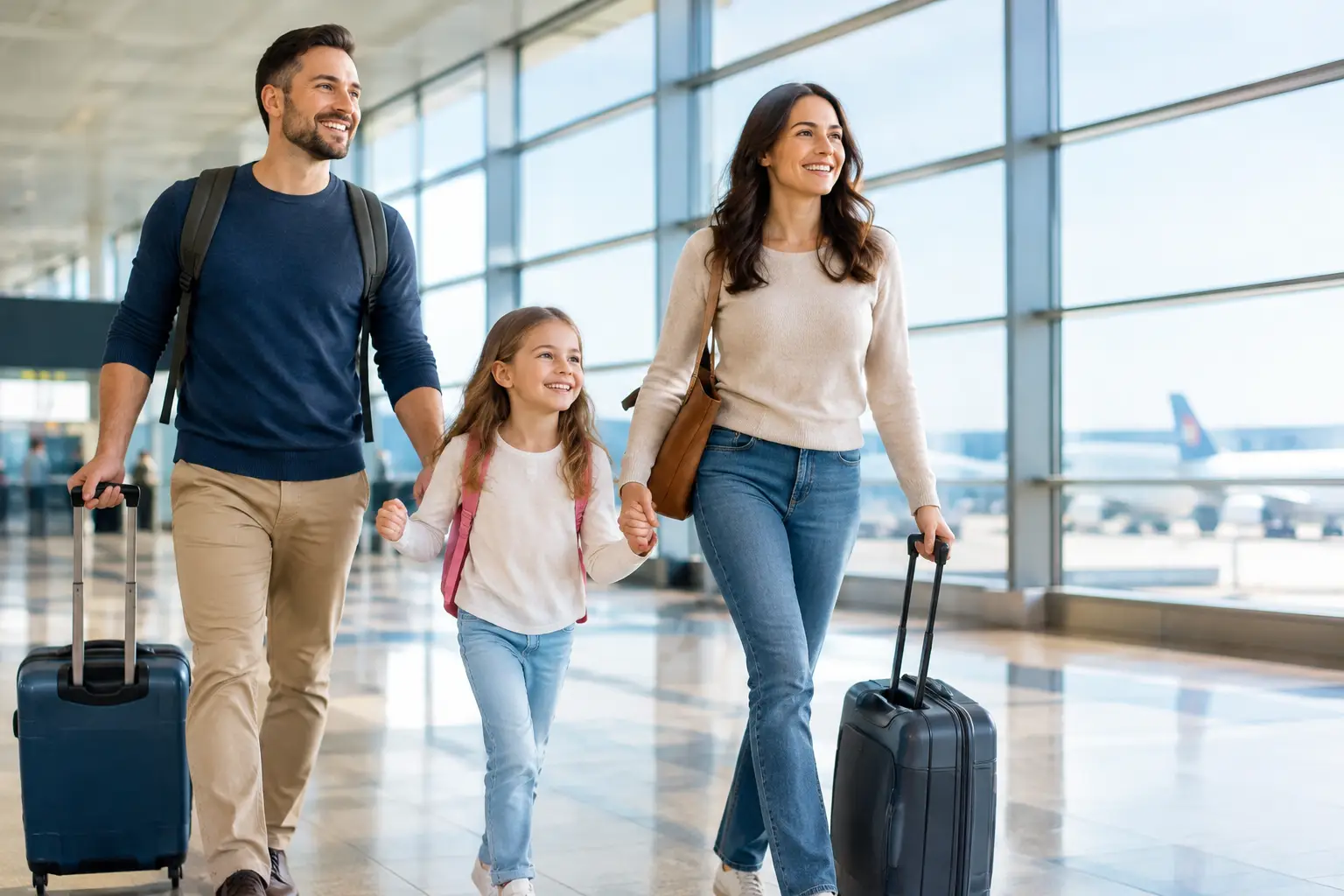
A family airport journey example is most useful when it reflects the moments that actually create pressure: locating passports, managing bags, getting through security without losing track of anyone, and reaching the gate with enough time to reset. The following realistic scenario shows how a family can make a morning departure feel organised rather than hurried.
The family airport journey example
Consider two adults travelling from Edinburgh with children aged seven and 11 on a 10.30am flight. They have checked their airline’s baggage allowance, completed online check-in and selected seats the day before. One medium suitcase is checked in, while each person has a small cabin bag.
Their plan is not built around the published departure time alone. It starts with the airline’s recommended airport arrival time, then adds a practical buffer for the family’s own pace. A child who needs the toilet just as the car arrives, an unexpectedly busy drop-off area or a queue at bag drop can each take longer than expected. Building in that margin is calmer than trying to recover lost minutes later.
The evening before, passports, boarding passes and any required travel documents are placed together in one document wallet. The adults confirm that names on bookings match passports, check the terminal information and look at the destination weather. The children choose one small comfort item and one quiet activity for their cabin bags. This limits the number of loose belongings to monitor during the journey.
At home, the family labels their checked suitcase and takes a photograph of it. That is not a substitute for keeping baggage receipts, but it makes identifying the case easier if needed. Liquids and larger toiletries are packed in checked baggage where permitted. Cabin bags hold only what will be genuinely useful before landing: medicines required during travel, snacks that comply with airline and border rules, a spare top for younger children, headphones, chargers and reading material.
Leaving home without a last-minute search
On the morning, the adults aim to have the main packing complete before the children are dressed. Breakfast is simple and familiar. Nobody needs a stressful introduction to a new food before a flight.
Before leaving, one adult takes responsibility for travel documents and mobile phones, while the other does a final room check. It is a small division of duties, but it prevents both adults assuming the other has packed the passports. The check is practical: doors locked, cooker off, documents present, cabin bags present, checked bag present.
For a pre-arranged vehicle journey, the collection point should be obvious and easy to access with luggage. Families benefit from agreeing who will handle each bag before the vehicle arrives, rather than trying to coordinate around a boot or pavement. If a family has unusually bulky luggage, a pushchair or sports equipment, confirming vehicle space in advance avoids an uncomfortable surprise on the day.
Arriving at the airport
At the terminal, the family keeps its pace measured. Rushing often creates the very delays people fear: a dropped boarding pass, a bag left by a seating area or a child becoming upset before security. One adult stays with the children while the other checks the departure screens and identifies the airline’s bag-drop area.
If bags need to be checked, the family deals with this first. The children can help by staying beside the trolley and keeping hold of their own cabin bags, but adults should retain passports and boarding passes until the bags have been accepted. Once the suitcase is checked, the family has fewer items to manage and can move towards security together.
It helps to explain the next stage in plain terms. Security is not a test for children to worry about. It is a set of checks that everyone completes before flying. Tell them that bags may go through a scanner, they may need to remove outer layers or follow instructions from staff, and the family will meet again immediately after the screening area.
Making security less stressful
Security rules can change, so travellers should always check current guidance from their departure airport and airline before packing. The key is to avoid discovering restricted items only at the tray.
Before reaching the front of the queue, the adults organise pockets, documents and bags. Electronics and liquids should be ready to present if required. Loose coins, toys and forgotten snacks create clutter, so place small items securely inside a bag rather than scattering them across several trays.
The family moves through as one group where possible. The seven-year-old goes between the adults, while the older child is given a simple role such as carrying a light cabin bag and listening for instructions. Once through, the priority is to collect every item before moving away from the belt. A quick count works well: four people, four cabin bags, document wallet, coats and any tray items.
There is a trade-off here. Trying to be perfectly efficient can make everyone tense. Taking an extra minute at the repacking area is preferable to walking away with a passport in the wrong bag or a jacket left behind.
The time between security and boarding
After security, the family should avoid immediately settling into a restaurant or shop before checking the departure board. Gates may not be announced straight away, but the board confirms the flight is still displayed as expected and gives a sense of where facilities are located.
This is the best point for a toilet stop, refilling water bottles where facilities allow, and buying a modest amount of food if needed. A full sit-down meal may be worthwhile on a longer journey or when the airport is quiet. On a short-haul flight with a gate likely to be some distance away, a lighter option is often more sensible. The aim is to avoid both hungry children and a rushed dash from the restaurant when boarding begins.
Give each child a clear boundary. They may look in a shop with an adult, for example, but they do not wander ahead or return alone. Airports are controlled environments, yet they are busy, unfamiliar and full of distractions. Children do better with specific instructions than vague reminders to behave.
A useful rhythm is to check the departure board after any activity that takes more than 15 or 20 minutes. If the gate is announced, make your way there promptly. Some airports involve longer walks, escalators, lifts or a bus to the aircraft. Arriving near the gate early gives the family time for another toilet break and allows everyone to board without becoming the last passengers in the queue.
Boarding as a family
When boarding is called, have passports and boarding passes ready before joining the line. Do not rely on finding them while balancing bags and moving forwards. If the airline has a boarding group, follow it rather than trying to board early without being called; queues are easier when families are not pressing around the gate.
On the aircraft, one adult can take responsibility for stowing larger cabin bags while the other helps the children into their seats. Keep essentials accessible under the seat in front where permitted: headphones, a book, tissues, a drink bought after security and any medication needed during the flight. Everything else can go overhead.
The first few minutes on board can be busy, particularly if the aircraft is full. This is not the time to unpack every activity. Start with one familiar, quiet option and save others for later. A simple snack, a book or downloaded entertainment is usually enough until the cabin settles.
What makes this example work
The value of this family airport journey example is not a rigid timetable. Every airport, airline and family is different. It works because the adults reduce decisions in advance, divide responsibilities clearly and leave room for normal interruptions.
The details that matter most are modest: documents stored in one place, bags that have a purpose, food planned rather than improvised, and enough time to walk instead of run. Families do not need a flawless airport experience. They need a plan that still holds together when someone needs a toilet, a queue moves slowly or a favourite toy has disappeared into the bottom of a bag.
A calm departure begins well before the terminal doors. Give yourselves time, keep the essentials close, and let the journey start at a pace everyone can manage.
Ready to book your journey?
Private chauffeur transfers and Highland tours from Edinburgh, booked online in minutes.
Book Online Instantly