
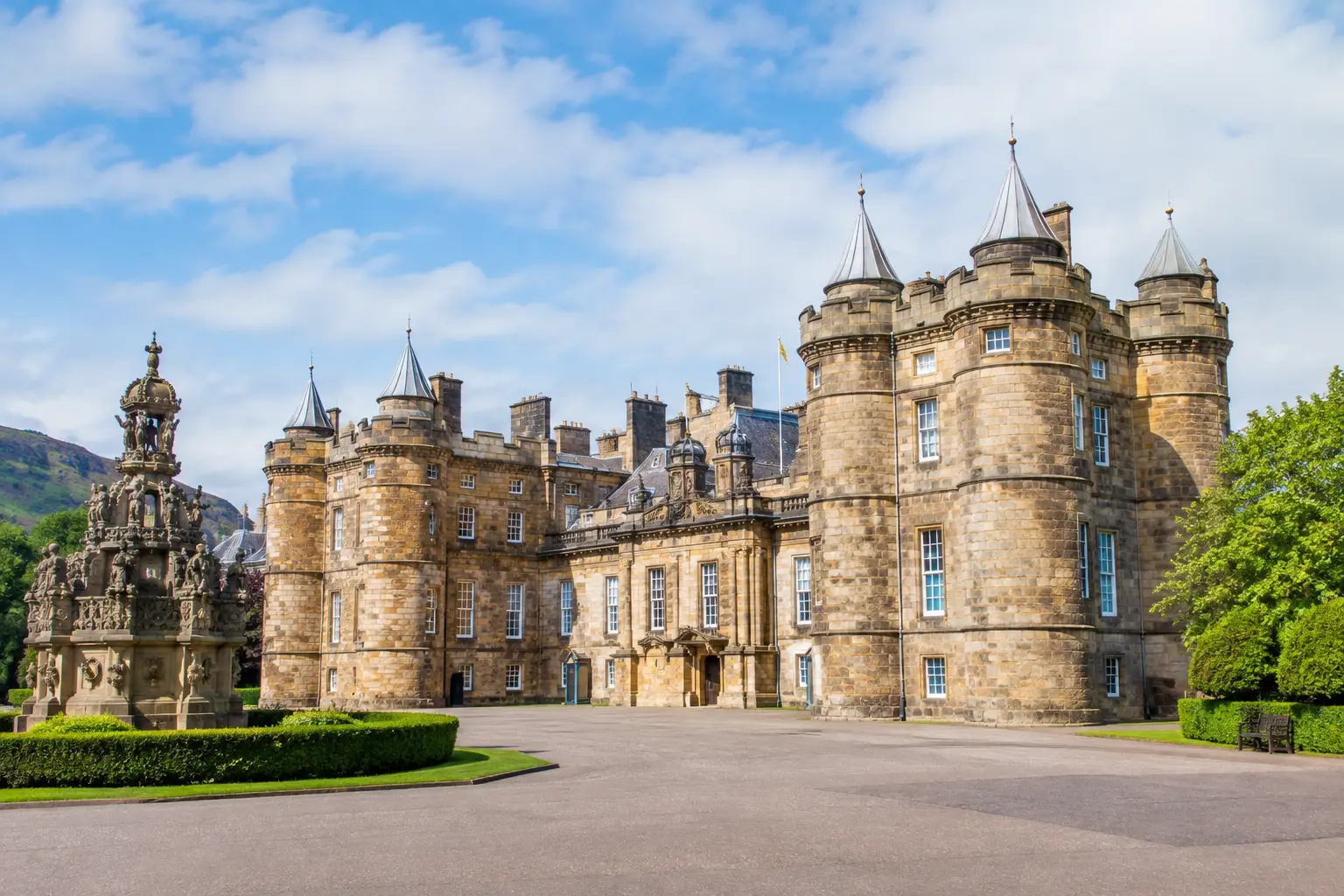
At the foot of the Royal Mile, the Palace of Holyroodhouse feels markedly different from Edinburgh Castle. Holyrood Palace visits are less about military spectacle and city views, and more about royal ceremony, private history and carefully preserved rooms still used by the Royal Family for official occasions. A little planning makes the experience far more rewarding, particularly if you are fitting it around a short stay in Edinburgh.
What makes Holyrood Palace worth visiting?
The palace is the official royal residence in Scotland, standing beside Holyrood Park and opposite the Scottish Parliament. Its setting is part of the appeal: Arthur's Seat rises behind it, while the Royal Mile begins just beyond its gates. Yet it is the human history inside that gives the visit its weight.
Visitors can usually see the State Apartments, where monarchs have hosted guests for centuries, and the rooms associated with Mary, Queen of Scots. Her chambers and the adjoining Outer Chamber are among the palace's most affecting spaces, shaped by the murder of her secretary David Rizzio in 1566. The atmosphere is deliberately restrained rather than theatrical, which makes the story more compelling.
The ruined Holyrood Abbey is included within the grounds and is worth allowing time for. Founded in the twelfth century, it offers a striking contrast to the formal interiors of the palace. The roofless nave, weathered stonework and view towards Salisbury Crags give the site a quiet, almost detached quality, even on a busy day.
This is not necessarily the best choice for visitors who want a fast, high-energy introduction to Edinburgh's history. Edinburgh Castle generally has more to occupy families with young children or those interested in defence and warfare. Holyroodhouse suits travellers who value royal history, interiors, art and a more measured visit.
Before you plan Holyrood Palace visits
Opening arrangements can change around royal events, ceremonial use and seasonal schedules. Check the official visitor calendar shortly before setting out, rather than relying on opening hours quoted in older guidebooks. The palace may close at short notice when it is required for official business, and the gardens can have separate arrangements.
Advance tickets are sensible during school holidays, summer weekends and the Edinburgh festival period. Timed entry helps manage the number of people in the rooms, but it does not mean the palace will feel empty. Arriving near the first available entry time is usually the calmest option, while later afternoon can also be quieter outside peak months.
Allow around 90 minutes for the palace itself if you listen to the multimedia guide and take time in the abbey. Two hours is more comfortable for most adults. Add longer if you plan to visit the gallery, walk in Holyrood Park or continue up the Royal Mile afterwards.
What to bring and what to leave behind
Wear comfortable shoes, even if the palace is only one part of the day. Edinburgh's Old Town pavements are uneven, and a visit often involves walking between the Royal Mile, the Canongate and Holyrood Park. A light waterproof layer is more useful than an umbrella on exposed routes around the palace grounds.
Security checks are normal at a working royal residence. Travel light where possible and allow a little extra time at the entrance. Large bags may be restricted, and photography rules are likely to differ between the interiors, the grounds and temporary exhibitions. Do not assume photography is permitted indoors simply because it is allowed elsewhere in Edinburgh.
The palace provides a multimedia guide as part of the standard experience in many cases, but arrangements can change. It is a worthwhile companion, particularly in the State Apartments, where the significance of portraits, furnishings and ceremonial rooms is not always obvious at first glance.
The best way to structure your visit
The strongest itinerary depends on how much walking you want to do and whether this is your first day in the city. Holyroodhouse works particularly well as the southern starting point for the Royal Mile, rather than an attraction to squeeze in after hours on the castle esplanade.
Begin at the palace in the morning, then take a few minutes in the abbey once you have finished indoors. From there, you have three natural directions: uphill through the Canongate towards the Old Town; across the road to the Scottish Parliament; or into Holyrood Park for open space and views.
If you choose the Royal Mile, resist the urge to treat it as a single uninterrupted march to the castle. The Canongate has several worthwhile stops and is often less crowded than the upper stretch near St Giles' Cathedral. A slower pace leaves room for closes, small museums and the changing character of the street.
If you choose Holyrood Park, be realistic about conditions. The walk to Arthur's Seat is rewarding, but it is not a gentle stroll and can be unsuitable in strong wind, heavy rain or poor visibility. Even a shorter walk around the lower paths can provide excellent views without committing to the full climb. Sensible footwear matters more than enthusiasm here.
Pairing the palace with nearby sights
The Scottish Parliament is directly opposite and its visitor arrangements make it an easy addition for anyone interested in contemporary Scottish public life and architecture. It offers a sharp visual contrast with the seventeenth-century palace, though opening days and access can vary.
The King's Gallery at the Palace of Holyroodhouse may also be available depending on its exhibition programme. Its displays change, so it is best treated as an optional extension rather than assumed to be part of every visit. Art lovers may want to reserve extra time; others may prefer the abbey and park.
For a more relaxed afternoon, continue along the Canongate and stop for lunch before working uphill. This avoids backtracking and turns a palace visit into a coherent route through the Old Town. For visitors with limited mobility or little appetite for steep streets, a plan centred on the palace, parliament and lower park is more manageable.
Access, comfort and timing considerations
The palace has accessibility provisions, but historic buildings have practical limitations. Step-free routes, lifts, mobility assistance and companion arrangements can depend on the areas open that day. Contact the palace directly before travelling if accessible entry is essential, rather than leaving the detail to chance.
Parents should bear in mind that the visit is largely an indoor historic-house experience. It can work well for older children who enjoy stories of kings, queens and intrigue, but younger children may find the pace formal. The abbey and gardens provide useful breathing space afterwards.
Winter visits have advantages: fewer visitors, a more contemplative atmosphere and easier access to nearby restaurants and museums. The trade-off is shorter daylight, colder weather and the possibility of restricted garden access. Summer brings longer days and livelier streets, but also queues, higher visitor numbers and a greater need to book ahead.
August requires particular care. Edinburgh is at its busiest during the festival season, and streets around the Old Town can feel congested even when the palace itself is operating smoothly. A morning palace booking is often the least stressful choice, leaving you free to decide later whether you want to join the city-centre activity or step into the quieter parkland behind the residence.
A visit with the right expectations
Holyroodhouse rewards attention to detail. It is not a place to rush through in twenty minutes between larger attractions. The value lies in noticing how the palace has changed from an abbey guesthouse to a royal residence, and how it continues to function as part of Scotland's public ceremonial life.
Give yourself enough time to stand in the abbey after the main route, look back towards the palace façade and decide what comes next. Whether you continue up the Royal Mile or take the quieter path into Holyrood Park, that pause is often what makes the visit feel like part of Edinburgh rather than simply another ticketed stop.
Ready to book your journey?
Private chauffeur transfers and Highland tours from Edinburgh, booked online in minutes.
Book Online Instantly