
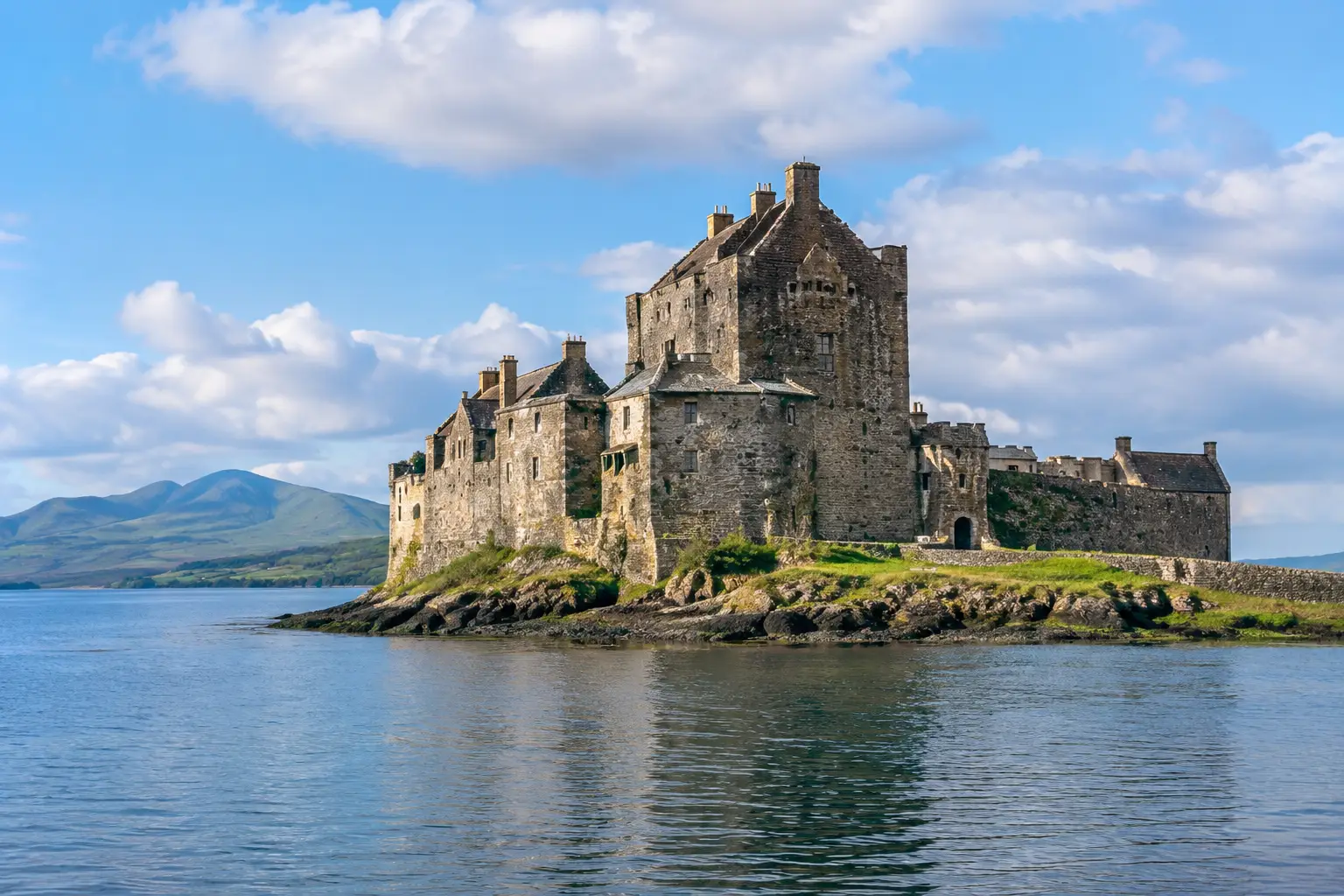
Blackness Castle sits low against the Firth of Forth, its dark stone walls projecting into the water like the prow of a ship. It is only a short distance from Edinburgh, yet feels markedly quieter than the capital’s major attractions. Knowing how to visit Blackness Castle properly means planning around its limited public transport, changeable Scottish weather and uneven historic surfaces - not simply arriving at the gate.
For travellers who value a well-paced day, the castle works particularly well as part of a West Lothian itinerary, alongside Linlithgow Palace, the Royal Burgh of Culross or a scenic drive along the Forth. Allow enough time to explore the building and the waterfront rather than treating it as a quick photograph stop.
Where is Blackness Castle?
Blackness Castle is in the village of Blackness, on the south shore of the Firth of Forth, roughly 20 miles west of central Edinburgh. The journey usually takes around 40 to 60 minutes by road, depending on your departure point and traffic conditions.
The castle’s waterside setting is a large part of its appeal. From the ramparts, there are broad views towards Fife and across the Forth. The village itself is compact, with a harbour, a few quiet lanes and limited visitor facilities. This is not a destination with numerous cafés, shops or indoor alternatives, so it pays to arrive prepared.
How to visit Blackness Castle by car or private driver
Driving is the most straightforward way to visit. From Edinburgh, the usual approach is west via the A90 and M9 corridor, following local signs for Blackness as you near Linlithgow and Bo’ness. Roads through the final stretch are narrower and more rural than visitors may expect, so leave a little extra time rather than relying on a tight arrival window.
There is parking near the castle, but capacity is limited. On bright weekends, during school holidays and when Scotland’s weather briefly behaves itself, spaces can fill quickly. An earlier morning or later afternoon visit is generally more relaxed.
A pre-arranged private journey can make sense if you are travelling as a family group, carrying luggage between accommodation stops, or combining several sites in one day. It also removes the need to coordinate infrequent local connections or return to a distant rail station at a particular time. The key advantage is flexibility: you can spend longer on the ramparts, stop for lunch in Linlithgow, or continue to another historic site without reshaping the day around a bus timetable.
Visiting Blackness Castle by public transport
There is no railway station in Blackness itself. The nearest useful rail options are typically Linlithgow and Falkirk, both connected to Edinburgh, followed by a local bus or taxi for the final section. This can work, but it requires careful planning because onward services may be limited, especially on Sundays and outside peak periods.
Check current train and bus timetables before committing to the route, and make sure you understand the last practical return connection. Do not assume that a service shown on a weekday will run at the same frequency at weekends or during public holidays.
Public transport is best for visitors who are happy with a slower, timetable-led day and do not mind walking short distances. It is less suitable if you have limited mobility, young children, a fixed dinner reservation in Edinburgh or only a small window for sightseeing. In those cases, road travel is usually the more dependable option.
Tickets, opening times and the best time to go
Blackness Castle is managed by Historic Environment Scotland. Opening dates, daily hours and ticket arrangements can vary by season, planned maintenance and special events, so check the official visitor information shortly before travelling. Buying or reserving ahead may be sensible on popular dates, but the right approach depends on the current admission system.
Summer brings longer daylight and the best chance of clear views over the Firth, but it also brings more visitors. Spring and early autumn are often excellent compromises: the landscape has colour, temperatures are usually comfortable for walking, and the site can feel calmer.
Winter visits have a different atmosphere. The castle’s exposed stone and coastal wind can make the place feel dramatically austere, which suits its history. However, shorter opening hours, slippery surfaces and poor visibility are real trade-offs. If a winter visit is important to you, build flexibility into the plan and dress for wind as much as rain.
Aim to arrive near opening time if photography matters or if you prefer quieter spaces. The main structure is compact enough to explore in around 60 to 90 minutes, though history enthusiasts and photographers may happily spend two hours there. Add time for parking, the walk from the car park and the waterfront views.
What to see inside the castle
Often called the ‘ship that never sailed’, Blackness Castle has an unusual shape: its tower and projecting walls give it the profile of a great stone vessel facing the Forth. It began as a 15th-century fortress for the powerful Crichton family, later served as a royal castle and state prison, and was adapted into an artillery fortification.
The central tower house, known as the Crichton Tower, gives a sense of the castle’s earlier medieval life. Other areas reveal its military role, including defensive walls, gun emplacements and substantial vaulted spaces. Look closely at the building’s practical details - thick walls, narrow openings and strategic sightlines explain more about its purpose than any romantic castle silhouette could.
The ramparts are a highlight, but take your time. Stairs can be steep and worn, surfaces may be uneven, and strong winds are common by the water. Children should be supervised closely, particularly on higher sections and near steps.
Blackness Castle has also appeared on screen, including as Fort William in the television drama Outlander. Fans will recognise aspects of its exterior and courtyard, but the castle is worth visiting on its own terms. Its real story, architectural character and setting are more substantial than a filming-location checklist.
Accessibility and what to bring
This is a historic fortress, not a modern gallery. Some ground-level areas may be manageable, but much of the experience involves steps, narrow passages, cobbles and uneven floors. Visitors with mobility requirements should review the latest accessibility guidance before setting off, as access can differ between parts of the site and may be affected by temporary works.
Wear shoes with a secure grip. Even on a dry day, old stone can be smooth underfoot, while the shore-side location is often breezier and cooler than central Edinburgh. A waterproof outer layer, an extra warm layer and something to protect a camera or phone are sensible choices.
There are limited facilities in the immediate area, so bring water and a snack if you are visiting outside lunch hours. If you want a proper meal, Linlithgow, Bo’ness and South Queensferry offer more choice and are easier places to plan around.
Make a half-day visit feel unhurried
The simplest half-day plan is to leave Edinburgh in the morning, reach Blackness Castle close to opening, spend 90 minutes exploring, then continue to Linlithgow for lunch and a walk around the loch. Linlithgow Palace is close by for those who want a second major historic stop, although combining both attractions properly can turn the outing into a full day.
Alternatively, pair Blackness with Bo’ness and the Forth shoreline. This suits travellers more interested in landscapes, small towns and industrial heritage than in ticking off the largest attractions. The route is especially enjoyable when daylight is long, but avoid overfilling the schedule: the charm of Blackness lies partly in having time to stand on the walls and watch the light change over the water.
Before you leave, confirm the castle’s current opening arrangements, check the weather at the coast rather than only in Edinburgh, and decide how you will return. With those details handled, Blackness Castle rewards a visit with something increasingly rare near a capital city: a powerful historic place that still has room to breathe.
Ready to book your journey?
Private chauffeur transfers and Highland tours from Edinburgh, booked online in minutes.
Book Online Instantly