
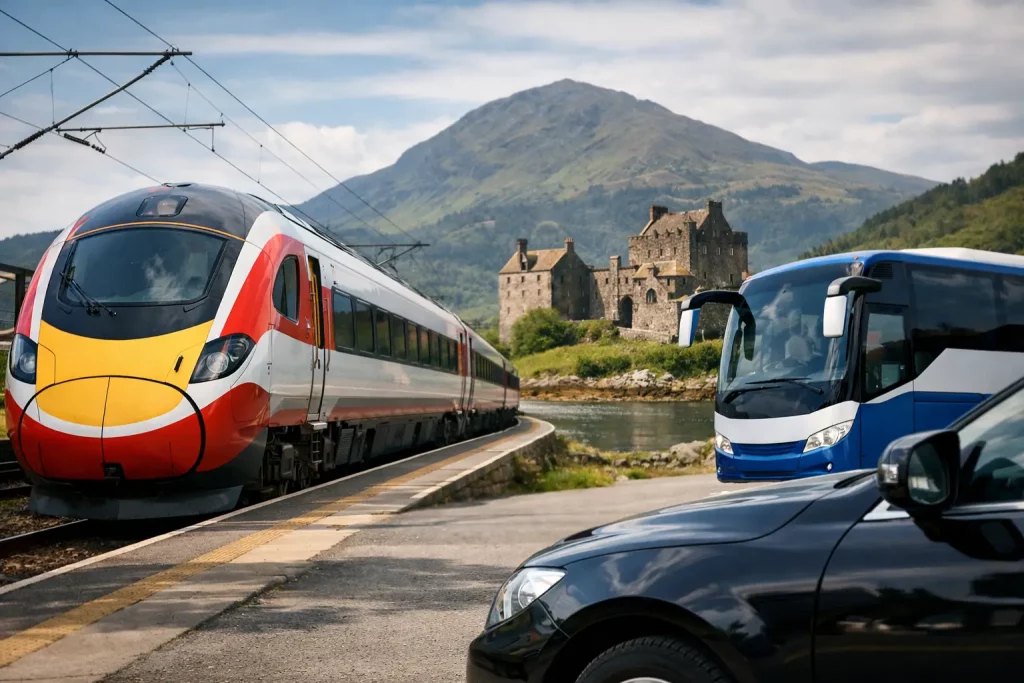
A delayed train into Haymarket can be an inconvenience. A delayed arrival for a board meeting in Glasgow, a tee time in St Andrews or a hotel check-in after a late flight is something else entirely. This Scotland intercity transfer guide is designed for travellers who need more than a basic ride from A to B – they need timing, comfort and certainty.
Across Scotland, intercity travel is straightforward on paper. The distances are manageable, major cities are well connected, and there is no shortage of transport options. The difficulty is choosing the right one for the journey you are actually making. Cost matters, but so do luggage space, schedule flexibility, weather, privacy and whether you can afford a missed connection.
Scotland intercity transfer guide – choosing the right option
The best transfer method depends on your priorities. Rail works well when stations are close to both ends of the journey and your schedule is flexible. Self-drive can suit confident motorists with light luggage and no issue navigating unfamiliar roads. For travellers who value punctuality, fixed pricing and direct door-to-door service, pre-booked private hire is often the more dependable choice.
That difference matters most on routes that look simple until the details appear. Edinburgh to Glasgow may be quick by train, but not if your destination is outside the city centre. Edinburgh to St Andrews is a common example where public transport often means a train, then a taxi, or a bus with luggage. Dundee, Perth and Aberdeen all bring their own variations depending on arrival time, traffic and onward plans.
A practical way to choose is to start with three questions. Do you need collection from an airport, hotel or office rather than a station? Are you travelling to a final destination that is not central? And is your timing fixed, such as a meeting, event, dinner reservation or golf booking? If the answer is yes to any of those, direct car service becomes more attractive very quickly.
The main ways to travel between Scottish cities
Train
Rail is often the first option people consider for intercity journeys, and for central-to-central routes it can be effective. Edinburgh to Glasgow is the obvious example, with frequent services and relatively short travel times. If you are travelling alone with minimal luggage and your destination is near the station, the train can be convenient.
The trade-off is that rail timetables decide the structure of your day. You still need transport to and from the station, and that can turn a short rail trip into a longer multi-stage journey. Strikes, engineering works, platform changes and late-evening service reductions can also affect reliability, especially if you are travelling after a flight or on a tight schedule.
Self-drive car hire
Hiring a car gives flexibility, particularly for rural itineraries or multi-stop travel. It can make sense for leisure visitors planning several days on the road, especially if they are comfortable driving in unfamiliar conditions. It also suits travellers who prefer complete independence.
Even so, self-drive has obvious drawbacks. Collection queues, excess rules, navigation, city traffic, parking charges and fatigue all need to be managed by the traveller. After a flight, an event or a full working day, that is not always appealing. Winter weather and evening driving on less familiar roads can make the option feel less efficient than it first appears.
Coach and bus
Coach services can be cost-effective, and on some routes they offer reasonable city-to-city coverage. For budget travel, they remain useful. For executive travel, airport connections or premium leisure journeys, they are rarely the first choice.
Travel times are longer, timetables are fixed and luggage handling is less controlled. If your priority is low cost above all else, buses have a place. If your priority is reliability, privacy and professional presentation, they usually do not.
Pre-booked private hire or chauffeur travel
Private hire offers the most direct route from one address to another. There is no parking to arrange, no station transfer to manage and no uncertainty over whether a driver will accept a long-distance fare at the time you need it. For many travellers, that predictability is the difference between a stressful journey and a straightforward one.
This is particularly relevant for airport transfer Edinburgh requirements, business appointments and longer leisure trips. A pre-booked executive vehicle allows you to travel on your schedule, with luggage space, onboard comfort and a professional driver who is focused on the route rather than improvising it. For clients searching for private hire Edinburgh or chauffeur Edinburgh services, that level of planning is often the main reason to book ahead.
Popular intercity routes and what to expect
Edinburgh to Glasgow
This is one of the easiest routes in Scotland, but only if both ends are close to the main stations. If you are travelling between offices, hotels, conference venues or private addresses, door-to-door car travel is often more practical than rail plus local transfers. It also allows for a quieter journey if you need to work or make calls en route.
Edinburgh to St Andrews
This route is common for golf travellers, university visitors and leisure guests. Public transport is possible, but it is rarely the simplest option with clubs, suitcases or a defined arrival time. A direct vehicle is usually the more comfortable choice, especially for small groups or guests arriving from the airport.
Edinburgh to Dundee or Perth
Both routes are straightforward by road and well suited to pre-booked executive travel. For business passengers, the benefit is less about speed and more about control. Leaving from an exact address and arriving at the final destination without changes reduces wasted time and keeps the day on schedule.
Airport to onward destination
Many intercity journeys begin at the airport rather than in the city centre. This is where pre-booked transport tends to outperform other options. After landing, most travellers want clear pickup arrangements, assistance with luggage and a direct journey onward. A connection involving tram, train or rank taxi may be cheaper on paper, but it often adds friction at the very point when convenience matters most.
When private hire makes the most sense
Private hire is not automatically the right answer for every trip. If you are making a casual daytime journey between two central stations and price is your only concern, rail may be perfectly adequate. But there are situations where a booked car service is the stronger option.
It makes sense when timing is fixed, when the pickup or drop-off point is not station-friendly, when luggage is significant, or when the journey is part of a wider business or hospitality experience. It also suits travellers who prefer discretion and a more polished standard of service than an ad hoc taxi or app-based ride can usually guarantee.
That is why many corporate and leisure clients choose an executive provider rather than waiting to see what is available on the day. With a professional private hire Edinburgh or chauffeur Edinburgh service, the vehicle class, collection time and route are agreed in advance. Pricing is also clear before travel, which avoids the uncertainty that can come with metered long-distance journeys.
What to check before booking an intercity transfer
Not all transfer services are equal, particularly on longer routes. The lowest quote is not always the best value if it comes with uncertain arrival times, vehicle quality issues or hidden charges. Before booking, it is sensible to check whether the fare is fixed, whether the driver is fully licensed, and whether the service is built around advance reservations rather than casual availability.
It is also worth asking practical questions. Will the vehicle comfortably hold your luggage? Is flight monitoring included for airport arrivals? Can the pickup be arranged from a hotel, office or private address at an exact time? For executive and premium leisure travel, these details shape the whole experience.
A strong provider should offer punctual collection, a clean executive vehicle, transparent pricing and clear communication before the journey. For longer trips, in-car charging and Wi-Fi can also be useful, particularly for business passengers working while travelling.
Scotland intercity transfer guide for business and leisure travellers
Business travellers usually focus on time control, reliability and presentation. They need a service that arrives when promised, allows them to work in transit and reflects well when transporting colleagues or clients. Leisure travellers may place more value on comfort, luggage capacity and a relaxed start to a hotel stay, golf itinerary or special occasion.
The overlap is clear. Both groups want the same basics done well – punctual pickup, a professional driver, a comfortable vehicle and a straightforward booking process. That is where a specialist provider such as AlbaGo fits naturally, particularly for travellers who want a premium standard without unnecessary complexity.
For Scottish intercity travel, the smartest choice is rarely the one that looks cheapest at first glance. It is the option that fits the actual journey, the actual timing and the actual standard you expect. When the trip matters, a pre-booked transfer gives you more control over the parts of travel that usually go wrong.
If you are planning travel between Edinburgh, Glasgow, St Andrews, Dundee, Perth or beyond, think beyond the map and consider the full door-to-door journey. The right transfer should feel calm, punctual and properly handled from the moment you are collected.